Saturday, 15 May 2010

Animal Kingdom!


DEBBIE:

The beginning of our trip involved a few slight setbacks in the form of purse-theft in Kampala followed by tricky bank troubles in Fort Portal. However, after a couple of stressful days we put these inconveniences behind us and started to enjoy our newfound relaxed and stress-free lifestyle!

Fort Portal, in Western Uganda at the foot of the Rwenzori Mountains, offered us the chance to stay at the interestingly named ‘Exotic Lodge’ which cost us a grand total of £1 each for accommodation per night! Although far from exotic the rooms were clean and the staff were kind, which made our stay really enjoyable. The weather here was a far cry from the super hot Gulu that we were used to but with our raincoats packed we decided to take a trip out of the town to explore the countryside on mountain bikes. The views from the hills were quite spectacular and as we were cycling we constantly heard the choruses of the local children shouting ‘how are you, how are you, how are you!!!’ Mzungus (white people) on bicycles seemed to cause the locals a lot of amusement as they stared and giggled at us. We were unfortunate to get stuck in an almighty rain shower on the way back to Fort Portal but we warmed up with some good local style food back at the lodge.

KAREN:

Our onward travel took us to the Mweya Peninsula in Queen Elizabeth National Park – 1978 sq km of animal heaven! Staying deep within the park perimeters, the night air was filled with the sound of roaring lions, laughing hyenas, grunting hippos (‘ho ho ho’) and trumpeting elephants. Hearing activity outside our bedroom we were astounded by the sight of two elephants passing by our window! Watching the rangers trying to move them on was like a game of cat-and-mouse as more elephants continued to arrive and tear down trees! During our time in the park we saw hundreds of elephants, often way too close for comfort as they came within metres of our vehicle. An evening game drive proved to be the most exciting but perhaps the most hair-raising and exhilarating of our experiences. Driving back to our accommodation, a sizeable herd of elephants reluctantly took their time to clear from the road. A few minutes later a baby elephant stood alone in the road distressed at being parted from the main herd. Almost immediately a hippo ran across our path followed by 2 savage hyenas. We sadly learned that the elephant calf later became dinner for the hyenas. I can only describe Queen Elizabeth National Park as one of the most magical places on earth!

DEBBIE:

From the north of Queen Elizabeth National Park we travelled south to Ishasha, hoping to see the native tree climbing lions. After 7 hours of game driving in Mweya without spotting any lions, we were hoping to catch some down in Ishasha. As we drove from the park gate I heard a gasp from Karen sitting in the front seat of the car and we stopped to see 2 lionesses sitting by the side of the road!! We were also lucky enough on our game drive the next day to see a male and a female lion on the roadside. We were ecstatic to finally see these amazing creatures.

Our accommodation resembled a local style hut with great views over the savannah. The ranger who guarded the site was not too reassuring when he told us that, the previous night, the campsite had been stalked by 4 lions! The evening was full of animal noises (which was slightly scary) and we had a visit from a bat in the middle of the night which caused us some amusement as we tried to coax it out of our room!

KAREN:

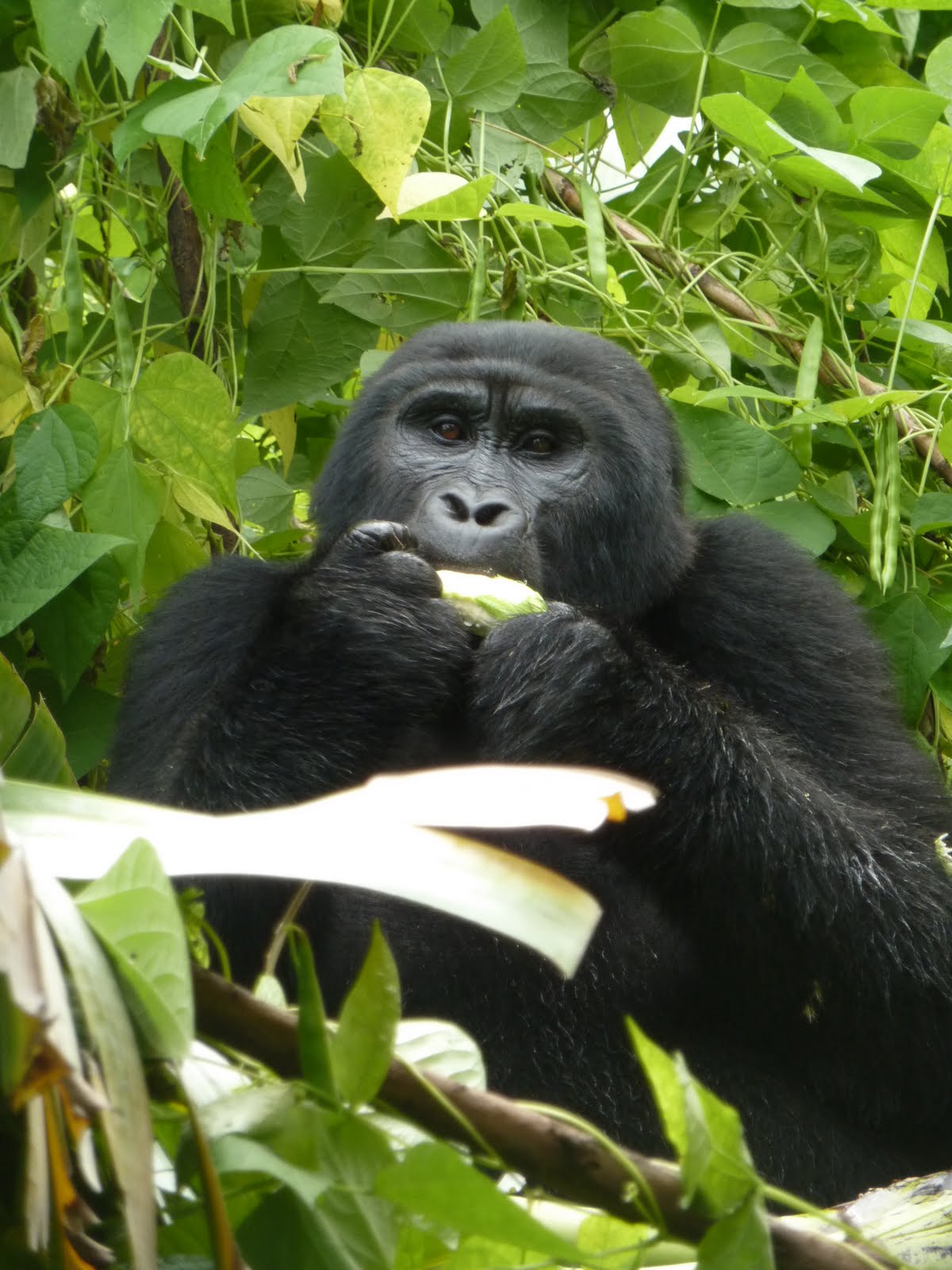
Bwindi Impenetrable National Park became our next stop. With an altitude span of 1160-2607 metres, the steep rolling rain forest mountain scenery and countless tea plantations felt very unlike Africa! The purpose of our visit...to trek the endangered mountain gorillas. The Ugandan jungle-forest is home to half of the 700 surviving gorillas worldwide. The remaining populations live over the borders in Rwanda and The Democratic Republic of the Congo. Conservation efforts only allow the Uganda Wildlife Authority to release 24 permits a day to trek 3 different gorilla families within the park and so it is a privilege to view these magnificent animals. Our trek followed the path of the Rushegura gorilla family. Lead by a humungous silver back male we were fortunate to view 16 of the 19 family members, including two babies. Such breath-taking animals! Visitors are restricted to 1 hour viewing and a 7 metre distance rule to prevent the gorillas becoming overly familiar with human contact and to reduce the risk of disease transmission. As we watched on, the unruly group ran down the hill onto community land and wreaked havoc in a banana plantation, causing much damage to the crop, and indeed the livelihood of a local farmer. Pulling down trees and crushing the crops, the animals had a right old feast, swallowing bananas whole before the rangers eventually chased them away. We were relieved to hear from the land owner that gorilla-trespass is only a bi-annual event.

To have viewed so many animals in the wild has felt like a dream come true and the most magnificent reward for all our efforts and hard work over the last 6 months. May the good times continue to roll in our remaining 3 weeks in Uganda!


(Disclaimer: Photos to follow when decent internet connection available, in the mean time we encourage you to use your imagination! Thank you very much for your patience!)

Wednesday, 5 May 2010

Good Bye Gulu!


KAREN:

The time has come to say goodbye to Gulu! Our mission is now complete! What an incredible 6 months we have had here in Uganda! Whilst volunteering at Gulu Regional Referral Hospital has been the challenge of a life time, we will forever cherish the memories and friends created by this experience. Goodbyes have been far from easy...

DEBBIE:

We've had a week of saying our goodbyes to the great people of Gulu...and what an emotional week it turned out to be! We were overwhelmed by the reactions of our Gulu friends to our leaving.

Our friend Rosemary who is a tailor in the market spent a whole afternoon trying to find us at the hospital and around town to present us with a bag and two purses each that she had made for us! Such a generous gift from someone who has very little for herself. She found us sheltering from the rain in the local cafe where, minutes earlier, we had reduced our waitress friend Maggie to tears when we had told her that we were leaving the next day. We had explained a week previously that we were leaving Gulu but Maggie said that she had thought we were joking! She then wrote us both lovely cards thanking us for being great friends to her and her niece Rita. A phone call then came through saying that Flavia, one of the nurses from the hospital, had arrived at our house with gifts for us! Flavia left us two wonderful figurines of Acholi people in Ugandan dress on bicycles which will be great reminders of the alternative travel that occurs in Gulu! Karen's had a pregnant lady on the back of the bicycle and mine had a huge pile of Matoke strapped to the back! (savoury green bananas). The kindness shown to us has been amazing.

We were fortunate to be able to share our final week with some very enthusiastic colleagues from UHSM who were busy teaching the medical students of Gulu University. It was a great opportunity to share some of our experiences and have a small piece of Manchester with us as we said goodbye to Gulu. The group were full of great characters and although the week was extremely busy for all involved (courtesy of the Icelandic volcano!) we enjoyed having them to stay and we hope that they enjoyed their visit...despite a gas leak, constant power cuts, water shortage and then, ironically, a flooded house!!!


KAREN:

The hospital arranged a farewell party in our honour. Expecting nothing more than a small gathering of staff, we were quite taken aback when an hour before the party we were presented with a formal agenda of speeches, and a marquee was erected in the hospital grounds! It really brought home to us how much our work has been recognised and valued by the hospital staff. Many kind words of gratitude were spoken compounding the emotions we were already feeling at saying goodbye to people that have not only been our colleagues but also our friends. Sadness soon turned to laughter when the 'Master of Ceremony' declared that at the end of our speech, Debbie and I were to demonstrate our best Acholi dance moves! We hope and pray the video footage is never made public!

DEBBIE:

Our final contribution to the Medical Ward at Gulu Regional Referral Hospital was one of the most satisfying achievements that we could mention. With the remainder of the money from the Easter distribution and some new donations, we hoped to provide every bed on the Medical Ward with a mattress with a waterproof cover. Unfortunately, when we went to the market to do some research with the Senior Principal Nursing Officer from the hospital we found that the best quality mattresses were far more expensive than we had anticipated. We decided to order mattresses for half of the ward, feeling frustrated that we were unable to fund the whole ward. It has been extremely upsetting for us to see so many sick patients lying on bare bed springs and we really wanted to change this for all of the patients.

In a great turn of events, after Marian Surgenor, our Global Health Link Lead, discussed the situation at the hospital, the Medical Superintendent agreed to match what we had been able to buy ensuring that the WHOLE ward could have new mattresses! Karen and I were overjoyed and can't wait for them to be delivered next week! Thank you to all those who donated towards making our patients on the Medical Ward much more comfortable.

KAREN:

Despite all the tears, frustrations and sorrows, our Gulu experience has been nothing short of amazing and thankfully the good times have far outweighed the bad. It would however, be fair to say that coming to terms with the clinical conditions at the hospital was difficult to say the least. Words and photos fail to do justice to the poor conditions and the reality of life in Northern Uganda. Working in a developing country, we expected resources to be limited but when basic necessities like gloves, needles, syringes and cannulas weren't available, with a constant absence of essential drugs, it made for a desperate situation.

I like to hope that Debbie and I have made a difference, even if its just a ripple in an expansive ocean. If nothing else, we made patients and their relatives smile as we amusingly attempted to master the local Acholi language! In a farewell speech, one of the consultants commented that he thinks patient number may have increased during our time at Gulu Regional Referral Hospital as many local people wanted to be cared for by the two 'mzungu' (white) nurses in town...I'm not sure our aim was to actually increase the burden on hospital facilities!

The support shown to us by our families, friends, and UK colleagues has been overwhelming and has meant so much and been extremely encouraging. We were particularly spurred on in our final weeks when we learnt that we had received a 'One Talented Team' award from the University Hospital of South Manchester (UHSM) for our work in Gulu - we are now officially award winning nurses! Now the time has come to hang up or uniforms and spend the next 5 weeks travelling around the South, East and West of this beautiful country that we have been fortunate to call 'home' for the last 6 months. Watch this space for the next chapter of the Karen-and-Debbie Uganda travel adventures!

Thursday, 22 April 2010

Our Mission is almost Complete!


KAREN:


As our time in Gulu draws to an end we have been reflecting on what an amazing experience we have had in Uganda. The last six months have been challenging to say the very least but thankfully the good time have far outweighed our sorrow and frustrations!


We finished work at Gulu Regional Referral Hospital last Friday. Saying that we still have a series of lectures and presentations to make and so our mission in not yet complete! Our send off from the hospital staff was very moving with much praise from the Senior Principle Nursing Officer and the Chief Nurse for all our efforts at the hospital. By the end of their speeches we resorted to feeling like we were once again 10 years old and the 'teachers pet!' We were glad to have an opportunity to offer our thanks to the staff for all their support and new found friendships. Our official duties were completed by the staff singing us the Uganda Nursing Anthem:


"We have been chose, we have been chosen (high pitched!)

Chosen by God, chosen by God,

Chosen to be Nurses, chosen to be Nurses,

Our Holy people, to love and serve."


A thank-you and farewell party is being planned by the hospital staff in our honour for tomorrow night! Such gratitude has been show to us for our work and many of the nurses have thanked us by inviting us to their homes and preparing us a feast of local specialities: beef or chicken stew (chewy meat no longer repulses us!), malekwang (green leaf in peanut and sesame sauce), posho (a white bouncy lump of maize), kal (a brown bouncy lump of millet), rice, chapatti, sweet potato, bans (obligatory!), boo (pronounced 'bo') and dodo (chopped flavoured green leaves). One spread even included the local delicacy of 'bush rat' - you may well wretch - I certainly did! The challenge is to eat until you are ready to explode...and then eat a little more! We are always humbled by such a spread of food as people here have so very little yet always share so much. The average pay of a nurse is £100-£200 a month and often wages are late in being paid.


Our friends homes have ranged from modest houses to simple mud huts. With the UK housing market being so expensive we are contemplating building ourselves mud huts on our return to Britain! To be invited to a local village is something we always feel is a real honour especially when the whole community want to greet us and the children run up to us shouting "mwnw, mwnw, mwnw!" (white person) with such excitement and giggle when we respond with a smile or a wave! With such pride, Sister Caroline, our Chief Nurse, took us for a walk around her village introducing us to the community by our Acholi names: Lamaro Karen - meaning I show passion and dedication, and Aber Deborah meaning beautiful good girl. Traditionally if an Acholi name is shared with an elder, a chicken should be offered which means that by now we would have our own chicken farm! Sister Caroline showed us the spring where water is collected for cleaning and washing and the bore hole from where drinking water is pumped. The heavy canisters of water are then carried home on the heads of local women. She also gave us a cookery lesson teaching us how to prepare local food and showed us how to plant ground nuts on her land. We are now officially Gulu Girls!


DEBBIE:


Along with the great friends that we have made by working with the nurses at the hospital we must also mention the patients. We've met some truly inspirational patients and relatives on the ward who cope with so much in such a humbling way. Relatives here (referred to as the patients 'attendant') have to care for their family member 24 hours a day and their dedication is amazing. Some people, however, do not have adult family members to preform this vital role and so the responsibility falls on their children. Here is an example:


A patient was admitted onto the ward and was very sick with chest problems. When she arrived she was sitting on the floor by her bed looking like she didn't have the energy to move. A young girl followed and began attending to the woman and helping her into bed. This young girl, aged around 6 or 7 years, was the sole carer for this patient: her mother. Each day she cooked food, fetched water and cleaned clothes for her mum. The girl and her mother had very few belongings and it transpired they had fled from the Democratic Republic of Congo to Uganda for safety, speaking volumes about the state of affairs in the Congo. The isolation felt by this mother must have been huge as she could not speak the local Gulu language of Acholi and spoke little English. Thankfully one or two nurses were able to speak her native tongue of Swahili but these staff were few in number.


One day on the ward we brought some sparkly masks left over from a Christmas parcel we had received. The little girl was fascinated with the mask and wore it all day! From this day forward we were considered to be her friends and every time she saw us she ran up the ward to give us a cuddle and a huge beaming smile! Her mother was diagnosed with Tuberculosis (TB) and thankfully started on the appropriate treatment but remains very sick. This situation seemed so desperate to us but is simply accepted by these two strong-willed ladies who coped so well. Extraordinary!

Friday, 9 April 2010

An Easter Present...


At Christmas time some friends from the company 'Cargill Cotton' worked hard to raise money for our patients at Gulu Regional Referral Hospital and we also received some very kind donations from friends and relatives. With the money we had planned to give each patient at the hospital a small Christmas gift. Unfortunately, Karen fell ill the week before Christmas and so we were unable to carry this out. However, as Easter came around we thought we'd try again and provide an Easter distribution instead!


We decided to give each patient a very English treat - tea, milk, biscuits and sugar! With 250 beds at the hospital the scale of organisation could not be underestimated as Karen and I went to the market and bought 300 sachets of tea, 15 kilos of sugar and 23 litres of milk! We made some of the market sellers very happy that day. We also needed something to package the gifts in and so we went to an older man in the market who sits selling plastic bags all day. Whenever we see him he always tests our Acholi language skills and gets very excited when we can answer his greetings! When I asked him for 300 'caveras' (bags) I don't think he could believe his ears! He was overjoyed when I handed over 30,000 shillings (just under 10 pounds).


On wednesday night, while the local bakery were making the 600 biscuits we had ordered, Karen and I started a production line arranging the sugar and tea into all of the bags. This job took us 3 hours into the night and left Karen and I feeling slightly hysterical with tiredness and absolutely covered in tea and sugar!


Thursday was distribution day. After hiring a vehicle to transport everything to the hospital one of the lecturers at the medical faculty very kindly let us use his office to sort out what was to go where (we rewarded him with some left over biscuits). We started by going to the Nutrition Ward and Paediatric Unit where the mothers were extremely grateful for our little gifts and we had a great time greeting all of the patients and talking to the staff. We even got a round of applause when leaving the Paediatric Ward! We then went to the TB Ward, Acute Paediatric Unit, Casualty, Surgical Ward, Medical Ward, Maternity Wing, and Mental Health Unit. We had some amazing reactions while going around the hospital. One older lady in the Surgical Ward gave both of us a huge hug and had the biggest grin on her face - it was priceless. We had extra parcels and so managed to share these with members of staff that were on duty who were also very grateful. Such a small present caused such excitement around the hospital, it was so great to see. Thank you so much to all of our donors for allowing us to distribute an Easter present to each and every one of our patients! It was a day that Karen and I will never forget.

Wednesday, 31 March 2010

A Taste of Paradise!


I had a dream of powder white sand beaches, vibrant aqua marine crystal waters set against perfect blue skies, palm trees in abundance, endless rays of sunshine, and a daily feast of freshly caught fish brought directly off fishermen on the beach...then I realised that in fact I hadn't been sleeping... we had been on holiday to Zanzibar!


Physically, emotionally, and mentally exhausted, Debbie and I pressed the 'stop' button and along with our friends Apolo and Ben, left Gulu for a holiday. Zanzibar is radiantly beautiful and can only be described as paradise on earth! Words and photos cannot do any justice to this picture-perfect Tanzanian island. A traditional palm-roofed house was where we lucky enough to call home for a week - 'White Sands' so aptly named for its idyllic beach front location with jaw-dropping views across the ocean. One morning sleeping out under the stars, I was lucky enough to awaken to the most amazing sunrise I have ever seen - I thought my eyes were deceiving me as the burning red sun rippled through the clouds with the colours glowing vibrantly as they reflected off the peaceful waters. A sensational way to wake up!


Uganda is a remarkably beautiful country and we have enjoyed many a weekend adventure visiting the Rwenzori Mountains, exploring game parks, trekking rhinos, white water rafting, camping on the banks of the river Nile, and swimming in waterfalls and crater lakes. This time we decided to head a bit further afield and experience a bit more of East Africa and stay in a place with very few physical demands. Whilst both Debbie and I are relishing the opportunity to work in a resource-limited developing country, owing to the nature of our work at the hospital, there is only so long that it is possible to work without a break. And Zanzibar certainly proved a perfect way to recharge the batteries.


We filled our days swimming in the sea, reading, relaxing on the beach, and playing frisbee (yes indeed we really are big kids at heart!) and cooking up a daily fish feast of the fisherman's catch of the day - snapper (red, white, and black), sting ray, barracuda, lobster, and blue fish as well as others that remain nameless but tasted delicious! Physical activity extended to include windsurfing and I'm proud to say I am now 20meters proficient even if I did spend more time crash landing into the sea than upright on the board! For me a highlight was swimming with wild dolphins off the south coast of the island- a truly magical and unforgettable experience!


Our week in Zanzibar was poles apart from our life in Uganda. We knew we were back in Gulu when we returned home to a weekend minus power, an inconsistent mains-water supply, an empty gas cylinder, and a red ant invasion. As we sat on the porch with a glass of (poor quality) red wine toasting our holiday, we were attacked by flying ants and moths nose dived and drowned in our wine ...a proper local-style Gulu experience, and we wouldn't have it any other way!

Tuesday, 9 March 2010

THE CURSE OF NATURE


KAREN:


Nature can be so beautiful, nature can be so ugly. Nature can cause so much pleasure, nature can cause so much pain. On the evening of Monday 1st March 2010, tragedy struck Eastern Uganda when a landslide caused multiple deaths destroying four villages in the county of Bududa. Many people were buried alive as rocks, mud, stone, and water thundered down the foot hills of Mount Elgon submerging buildings, schools, health centres, and entire communities.
Stories and images of devastation dominate the news here in Uganda as a humanitarian emergency has been declared. Over 350 people are feared dead along with hundreds of livestock. Rescue efforts have been coordinated by the Uganda Government with the support of the military and humanitarian aid agencies. One week on and only 31 survivors have been rescued from the rubble and 89 bodies exhumed after disaster response teams and locals alike have been using hoes, pick axes, spades, and even their bare hands to dig in over 3.3 square kilometers of flattened terrain.
The 200m wide avalanche of mud and debris was triggered by endless days of downpours, more typical of the cool wet season, not the hot dry season that Uganda should be experiencing at this time of year. The affected villages of Nametsi, Kubehwo, Liira, and Matuwa have been declared disaster zones. Flooding due to the above average rain falls, is causing further problems in these regions of devastation. Over 1000 people in these villages have been made homeless. A total of 4000 people living in mud-slide prone areas have been advised and encouraged to evacuate their homes and seek refuge in temporary relief camps or in nearby villages. Oxfam, The World Food Programme, Save The Children, and UNICEF are amongst the aid agencies involved in distributing food, clean water, cooking utensils, blankets, and essential medical supplies to the people seeking refuge in the internally displaces peoples (IDP) camps. Medical teams have been flown in from Kampala, the country capital, reinforced by medical staff from nearby Mbale Hospital.
And with the flooding comes further misery in the form of water-borne infections and diseases from unearthed decomposing bodies. 80 cases of cholera have been confirmed in a neighbouring district - an acute intestinal disease caused by consumption of contaminated food and water which causes severe diarrhoea and dehydration. Minus prompt treatment, cholera can result in death. The concentration of people living in the IDP camps and temporary shelters can greatly increase the risk of disease exposure and transmission from over-crowding and utilisation of basic sanitation facilities. Aid organisations have been working hard to disseminate water purification packs in a bit to halt the introduction and spread of the disease and prevent the outbreak of an epidemic, with the International Committee of the Red Cross (ICRC) at the ready to treat 1000 cases should the need arise.

Although efforts to retrieve the bodies from the rubble continue, it is expected that President Museveni will declare an end to the search operation in the next day or two as chances of recovering bodies grows increasingly slim and excavation poses further public health risks. Not an easy decision when villagers so desperately want to provide the dead with a ceremonial and respectful burial.
Whilst response efforts are primarily focusing on immediate interventions in the aftermath of the landslide, longer term re-development planning is not being forgotten. In the proposed 5 year re-development programme buildings will be established to continue the education of the survivors of the 374 children in the affected areas. Homesteads will be constructed in safe locations. Land will be cultivated to replant the 792 hectares of damaged crops, predominantly consisting of maize, vegetables, cassava, banana and sweet potato, thereby contributing to future food security. Livestock will be replaced to compensate for the lost animals including 176 cows, 50 goats and 2000 chickens- essential sources of income and food for people in developing countries. Plumbing of water pipelines to the affected villages will be reconstructed, as well as sanitation and road infrastructures.
Living here in Uganda, it is difficult to know how far news of such a tragedy has spread to the outside world. And it is even more difficult to learn how such a tragedy has inflicted suffering in a country that has captured our hearts and that we have come to call "home" causing such loss to people and communities that already have so little.

Sadly the rain continues to fall...

Tuesday, 2 March 2010

Any one for a pint?


Last Friday I did one of the most rewarding things of my nursing career to date that perhaps directly saved a life...I donated blood to my patient. Returning empty handed from yet another trip to the hospital lab trying to acquire blood for transfusion for our patients, I felt compelled to help. Blood supplies are always in short supply in Gulu. Many patients here suffer with anaemia as a complication of malaria, and secondary to HIV anti retroviral medications. And when I say anaemia – I mean seriously low blood iron level. To any non-medical folk, a normal haemoglobin (HB) level is over 12.0, with UK patients receiving a blood transfusion at 8.0 or under. In Northern Uganda, patients are not transfused until they have a haemoglobin level of 5 or under – and it’s not uncommon to see levels at two or three!

My patient needed blood type A negative - a rare commodity at the best of times let alone from a blood bank with almost vacant supplies. Being a blood donor back in the UK, I was keen to offer a unit of my best claret to help my patient who was admitted with a HB of 4. Calling on my trusted side-kick Debbie, our interrogation of the Blood Bank staff began with us thoroughly investigating the Ugandan process of blood donation, and rigorously examining the blood collection equipment and ensuring the needles were indeed SINGLE USE! Assured by our findings we both decided to go ahead and donate! Before we knew it we had both donated 450ml of British blood to add to the dwindling supplies at the hospital. And just like home, the reward for your contribution...a sugary drink and biscuits – complete with smiley faces none the less!

We returned to the hospital ward with a standing ovation and a round of applause from our colleagues! And two hours later, after my blood had been screened and prepared, I was connecting it to my patient! Such a surreal feeling to know that it really could make a difference to the ultimate outcome of my patient! His family became so excited that they whipped out a camera and began snapping away as I went about connecting my bag of donated blood to the drip port cited in the arm of their relative. I was completely taken aback by this as I’ve never before seen a Ugandan with a camera!

And Im pleased to report that by today the patient was looking much better and has greatly improved. For once a success story where I feel incredibly proud to have played a significant role! Now we are keeping our eyes peeled to see if we are able to identify, by donor number, the recipient of Debbie’s kind contribution.

As the nurse in the blood bank said to us post donation “thank you for helping to save lives!”